
Rivian Range Calculator: How do ranges actually compare?
Want to learn more about Rivian?
This is the most exciting time to be alive when it comes to the pace of technology, software, and transportation.
I'm documenting what's new with Rivian, a software defined electric vehicle company, building fun things.
It would be my honor if you joined me.
Join the weekly Rivian Recap newsletter.
Every Friday @ 4pm Pacific.
Range numbers, explained for normal people
One of the biggest questions when buying any electric vehicle, but especially your first one is...
"But how far can it go between charging?"
This is a perfectly normal place to start when you think about how many fast charging stations there are vs gas stations.
As with all things, there's a bit of nuance here but it doesn't have to be nearly as complicated as many people make it.
The blame for overcomplicating the range question even falls on Rivian as well, who doesn't make it easy to do a comparison.
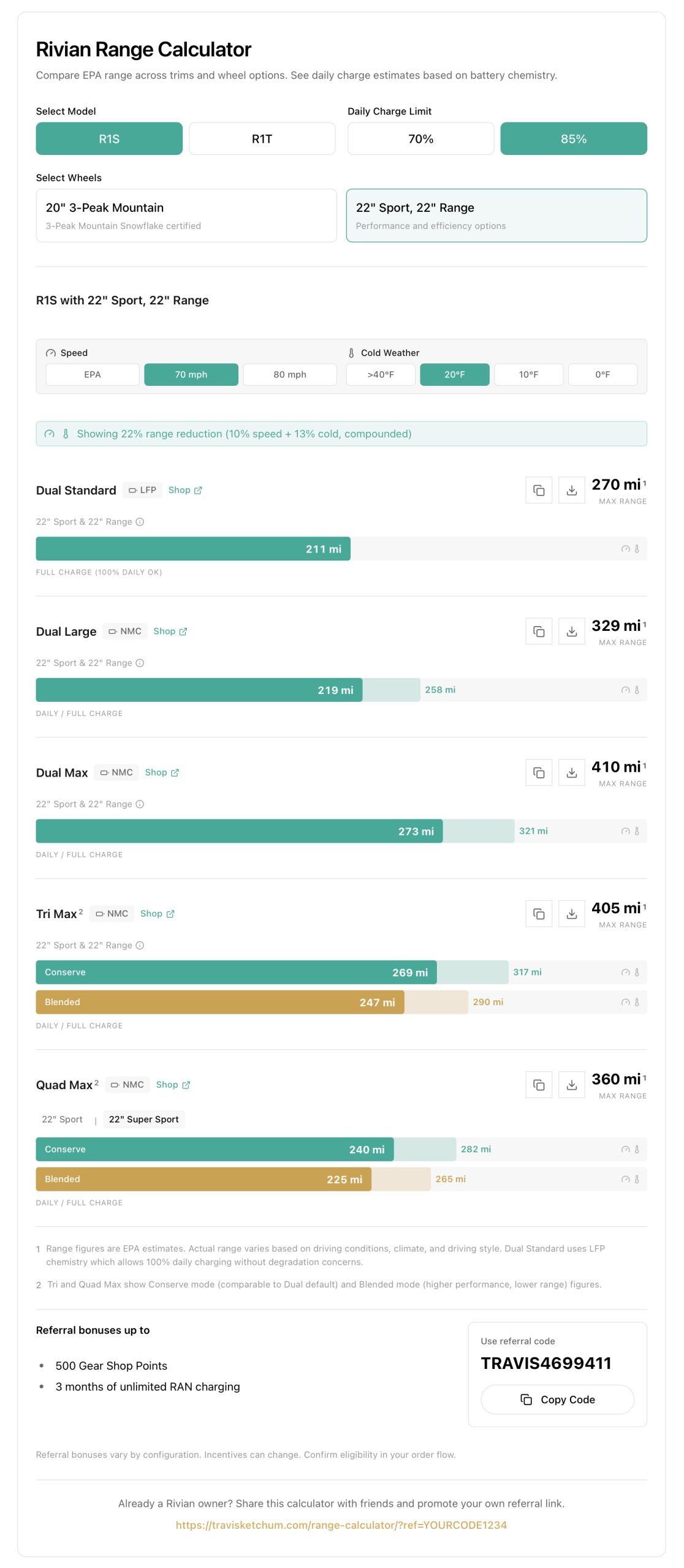
In fact, a big reason I built this range calculator was to help you visualize that some trims are not nearly the "upgrade" in range you'd expect, while others are far better than you'd imagine.
I'm going to break down the factors that matter and make walking away with real understanding a whole heck of a lot easier.

Factors that impact range, in 3 simple steps.
Range doesn't have to be the mysterious black box it's made out to be.
Factor 1: Battery Capacity
Probably the most intuitive factor is battery capacity.
Generally speaking, the larger the battery, the more range your vehicle is going to have.
There are diminishing return to this as you carry around more weight for larger packs, you lose some of the gains.
When it comes to the Rivian R1S and R1T lineup, you have three battery sizes that matter... with one wrinkle.
Standard (Gen2) - 92.5 kWh
The standard battery pack has a usable battery capacity of 92.5 kWh. This is the smallest battery pack that Rivian currently offers, but it is still pretty big by industry standards.
A standout feature of the "Standard" battery is actually the battery chemistry.
Powered by LFP cells (Lithium Iron Phosphate), this unique battery chemistry makes charging to 100% daily an acceptable practice.
While you'll have worse cold weather performance, and the batteries are heavier for the same amount of energy, the tradeoff for durability and daily range is worth it for most people.
Large (Gen2) - 108.5 kWh
With the Gen2 product line, the "Large" battery pack god considerably smaller with 108.5 kWh (22.5 kWh smaller than Gen1 Large batteries).
Large batteries and above have NMC (Nickel Manganese Cobalt) give superior energy density and performance, but are more vulnerable to battery wear when fully charged often.
As a result, Large & Max batteries do best with 70%-85% daily charge limits, making the large have fewer miles on a day-to-day basis compared to the objectively smaller "Standard" battery.
Max (Gen2) - 140 kWh
The largest battery that Rivian offers is aptly called their "Max" pack with 140 kWh of usable battery capacity.
You can get the Max Pack in all 3 motor configurations of Dual, Tri, and Quad Motors.
Each of them have their own trade-offs, but range is not nearly as big of a difference as you may expect at first glance.

See my 1 year review of our Dual-Max R1S 👇
Factor 2: Wheels & Environment
One of the most surprising point for anyone who hasn't been immersed into the world of electric vehicles, is just how much of an impact wheel choice makes on your range.
This is universally true across the Rivian lineup, but the more powerful powertrains seem to be impacted by this by having increased efficiency sensitivity.
For example, compare how much impact 20" 3-Peak Mountain Rated tires have on the Dual Standard vs Quad Max.
While not the same exact tires in terms of size, the Dual Standard loses just 4.4% (12 miles).
Compare that to the Quad Max that loses 12.5% (50 miles) and you start to get an idea that wheel choice is a big deal.
Wheel Considerations
You would be forgiven for drawing the conclusion that bigger wheels are somehow more efficient than smaller wheels.
However, it has far more to do with the tread and how much rolling resistance it has for the car to propel forward.
As a result, the more rugged All-Season and All-Terrain tires that have more tread and grip, actually have less range.
If we look at the staggered 22" Super Sport tires for the Quad Max for example, they actually have about the same range as the All-Terrain tires... despite being dedicated street tires.
Side note: The 22" 'Range' wheels have the same tires on them as the 22" 'Sport' wheels. The aero cover adds such minor efficiency that the EPA rated range is identical.
Environmental Factors
Counter to how highway efficiency works in gas powered vehicles, the faster you go the exponentially more energy you consume to propel the vehicle.
Speed Explanation
EPA: This is the public range figure you see on all electric vehicles. For Rivian this is a 50/50 mix of "Conserve" and "Sport" modes where applicable, and an average speed of 48 mph.
70 mph: If you sustain a speed of 70 mph, you can expect an approximately 10% reduction in range.
80 mph: With the exponential thickening of air at higher speeds, an average of 80 mph results in ~28% range reduction.
Cold Weather Explanation
>40°F: In temperate ambient temperatures, the impact to range is minimal. 55-65 is the sweet spot for range performance.
20°F: At 20°, the heat pump starts working harder and battery resistance rises. ~13% range reduction.
10°F: As the temperature drops, heat pump efficiency really falls off and reliance on resistive heating increases. ~23% reduction.
0°F: Here, the battery must self-heat to maintain performance and the heat pump provides little value. ~38% reduction.
Compounding Effects
The range reductions from environmental factors don't simply add, they compound. This is how a speed impact of 10% and cold weather impact of 13% can actually mean 22% range loss.

Factor 3: Drive Modes
You may be looking at the rated range of a Dual Max on Rivian's website and comparing it to the Tri Max feeling discouraged.
Could just one extra motor really dictate a loss of 39 miles (9.5%) when comparing the Dual and Tri motor?
The short answer is: NO.
What you're really seeing here is a difference in default drive modes for Dual Motor vs Tri Motor vehicles.
Tri Motor has a default "key up" mode that is full-time All Wheel Drive, compared to the dynamic AWD/2WD mode that Dual Motor uses as it's default drive mode.
A direct comparison here is the "Conserve" mode offered on the Tri Motor which works *exactly* the same way the default drive mode in a Dual Motor works.
When you compare a Tri Motor conserve mode, you only lose 5 miles, or about 1.2% range loss when equipped with the same wheels and tires across both trims.
1.2% for vastly improved driving dynamics and far superior drive mode options is a worthy trade off for car enthusiasts.


Wrap up: Data, Visualized 👀
Hopefully this simple range calculator makes it easy to understand and get a real direct comparison between the various trims and options that impact range in a Rivian.
The more clarity and truth we can bring to our data, the easier it is to make an educated decision.
If you ever have any questions or want to learn more, I'd encourage you to sign-up for my weekly newsletter or check out my videos on YouTube.
Until next time... Stay Curious! ✌️
Sincerely,
Travis Ketchum

